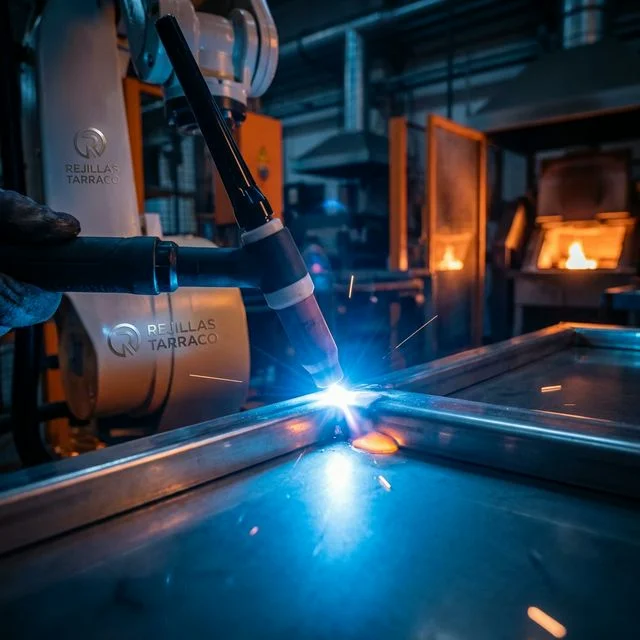
TIG welding (tungsten inert gas) or GTAW welding (gas tungsten arc welding) is
characterized by the use of a permanent tungsten electrode, sometimes alloyed with thorium or zirconium in percentages not
exceeding 2%.
Given tungsten's high temperature resistance (melts at 3410 °C), combined with gas shielding, the
electrode tip hardly wears down after prolonged use. The most commonly used gases for arc shielding
in this welding process are argon and helium, or mixtures of both.
GENERAL INFORMATION
The main advantage of TIG welding is obtaining stronger, more ductile, and less corrosion-sensitive welds
compared to other procedures. The shielding gas prevents contact between atmospheric oxygen and the
fusion bath, simplifying the welding of ferrous and non-ferrous metals without the need for
deoxidizers.
Another critical advantage is achieving clean and uniform welds due to the lack of fumes and
spatters. The gas transparency allows the welder to see the fusion bath clearly, directly impacting
the final quality of the joint.
CHARACTERISTICS AND ADVANTAGES
EQUIPMENT
The basic equipment for the GTAW system consists of:
Power source (DC or AC).
TIG torch with tungsten electrode.
Shielding gas supply (Argon/Helium).
High-frequency unit for arc starting.
Cooling system (optional for low currents).
BENEFITS
No spatter: Since filler metal doesn't travel through the arc, there are no projections.
High-quality welds: In all positions and with minimal thermal distortion.
Versatility: Welds practically all industrial metals, including aluminum and titanium.
Superior aesthetics: Clear, bright beads with a completely smooth finish.
TYPICAL APPLICATIONS
The TIG process is widely used in the food and pharmaceutical industries because it is an
extremely clean process that doesn't contaminate the base metal. It is also essential in:
Root welding in high-pressure pipes.
Heat exchangers and chemical reactors.
Aeronautical and precision components.
Fabrication of stainless steel structures and special alloys.