ES CA EN

Periodic table of elements

Published in Blog
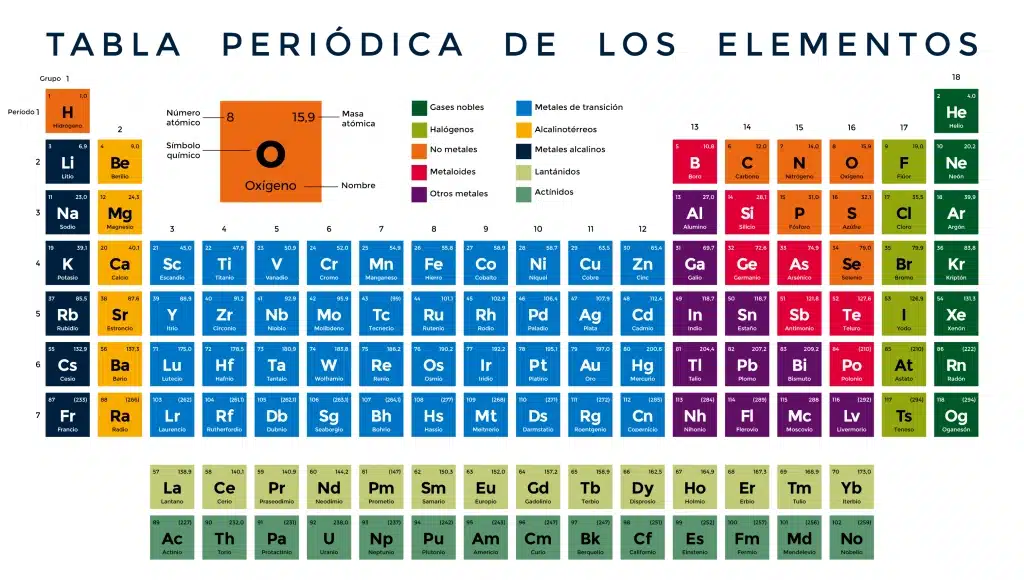
Periodic table of chemical elements - Click to view interactive version

The periodic table of elements is a tabular display of the chemical elements, arranged by atomic number (number of protons), electron configuration, and recurring chemical properties. This ordering shows periodic trends, such as elements with similar behavior in the same column.

Rows of the table are called periods and columns are groups

Rows of the table are called periods and columns are called groups. For example, Group 17 consists of halogens and Group 18 of noble gases. The table is also divided into four blocks with some similar chemical properties. Because the positions are ordered, the table can be used to derive relationships between the properties of the elements, or to predict the properties of new elements yet to be discovered or synthesized. The periodic table provides a useful framework for analyzing chemical behavior and is widely used in chemistry and other sciences.

Who published the first periodic table?

Dmitri Mendeleev published the first widely recognized periodic table in 1869. He developed it to illustrate periodic trends in the properties of the then-known elements, by ordering the elements based on their chemical properties. Julius Lothar Meyer, working independently, also carried out an ordering based on the physical properties of atoms. Mendeleev also predicted some properties of yet-to-be-discovered elements that he expected would fill gaps in his table. Subsequently, most of his predictions were proven correct when the elements in question were discovered.

Click on the table, you'll like it. You will access a full interactive version to explore each element in detail.

Related articles:

Back to Blog